

Oded Schechter, Daniel Boyarin, Libera Pisano, Avinoam Stillman, Stefan Goltzberg and Elad Lapidot
Winter School on
Modern Talmudic Hermeneutics V
Katholische Akademie Berlin in cooperation with the University of Lille and Södertörn University
December 16–18, 2025
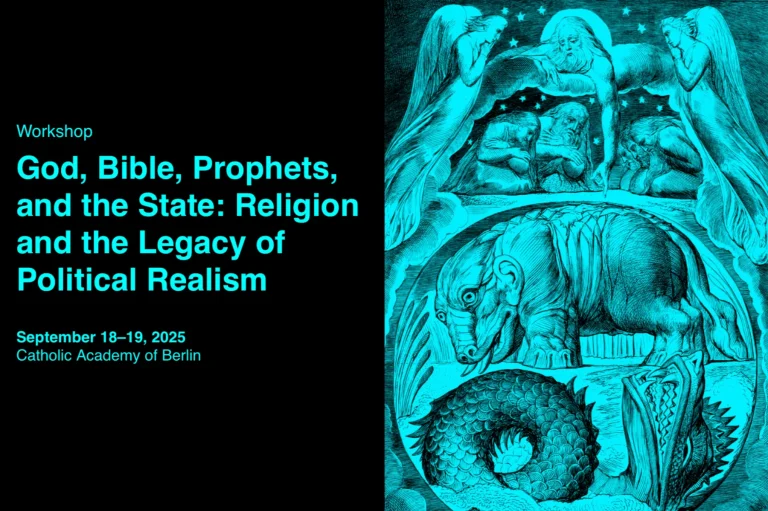
Image: AI
Winter School on Modern Talmudic Hermeneutics V
Oded Schechter, Daniel Boyarin, Libera Pisano, Avinoam Stillman, Stefan Goltzberg and Elad Lapidot
December 16–18, 2025
The Berlin Center for Intellectual Diaspora invites graduate students and early-career scholars to submit applications to participate in a master class on modern talmudic hermeneutics, which will take place on December 16-18, 2025, at the Catholic Academy in Berlin. The organizers will take care of accommodation and will partly reimburse travel costs upon request.
The winter school will be led by different instructors through guided readings in primary sources. The faculty includes Oded Schechter (Makhloykes Berlin), Daniel Boyarin (UC Berkeley, emer.), Libera Pisano (Universitat Pompeu Fabra in Barcelona), Avinoam Stillman (FU Berlin), Stefan Goltzerg (Université libre de Bruxelles) and Elad Lapidot (University of Lille/Katholische Akademie Berlin).
Activities will include classes on rabbinic hermeneutics, literature and modern thought, small group study sessions, open discussion and presentations of participants’ research projects.
Discussions will be held in English, basic reading proficiency in Hebrew will be an advantage, but is not required. The program is explicitly open to researchers also in fields beyond rabbinics, as well as scholars in other areas of Jewish thought, philosophy, hermeneutics, literature, religion, history or culture.
Cooperation
Katholische Akademie Berlin in cooperation with the University of Lille and Södertörn University


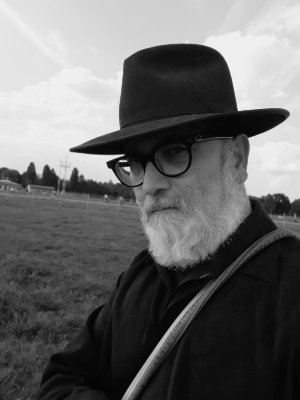
Oded Schechter is a philosopher and talmudist. He lives in Berlin and is the co-founder of the Berlin Makhloykes Center.
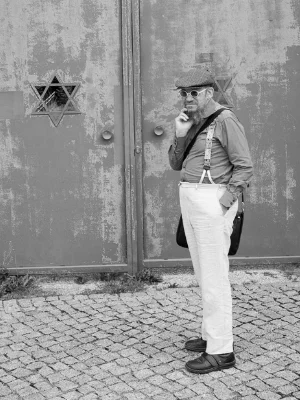
Prof. Daniel Boyarin is Taubman Professor of Talmudic Culture and rhetoric, UC Berkeley, ret. He has been an NEH Fellow (twice), a Guggenheim Fellow, a Fellow of the Institute for Advanced Studies in Jerusalem, a holder of the Berlin Prize at the American Academy in Berlin and a Ford Foundation Fellow. He spent the academic year 2012-2013 as a fellow of the Wissenschaft Kolleg in Berlin and was a von Humboldt Forschung Preisträgerat the FU Berlin in 2017. He is a fellow of the American Academy of Arts and Sciences since 2006.
Boyarin has written extensively on talmudic and midrashic studies, and his work has focused on cultural studies in rabbinic Judaism, including issues of gender and sexuality as well as research on the Jews as a colonized people, and lately, colonizing people. His most recent research interests centered primarily around questions of the relationship of Judaism and Christianity in late antiquity and the genealogy of the concepts of “religion” and “Judaism.” Lately he has been thinking extensively about diaspora as a political/cultural ideal. His most recent book is The No-State Solution: a Jewish Manifesto, Yale University Press, 2023.
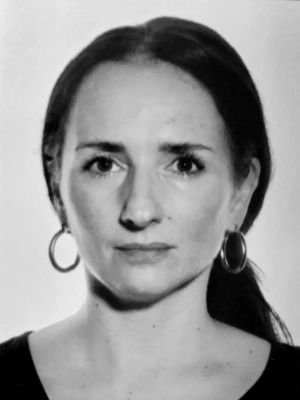
Libera Pisano is currently an Assistant Professor in Modern Philosophy at Pompeu Fabra University in Barcelona. She earned her PhD in Theoretical Philosophy from La Sapienza (Rome) in 2014 with a dissertation titled
Lo spirito manifesto. Percorsi linguistici nella filosofia hegeliana (ETS, 2016). She has been a Research Associate at Universidade Nova de Lisboa (FCT Stimulus of Scientific Employment, Individual Support), a Marie Sklodowska-Curie Fellow at University Pompeu Fabra in Barcelona, a Research Associate at University of Hamburg, and a Research Fellow at the Maimonides Centre for Advanced Studies, at the University of Calabria, and at the Humboldt University of Berlin. Her research explores the practical-political role of language, the interplay between exile and identity, and the theological-political dimension of community in modern German and German-Jewish philosophy. Her latest book, The Exile of Language: German-Jewish Philosophical Challenges to Linguistic Autochthony, was published by Brill.
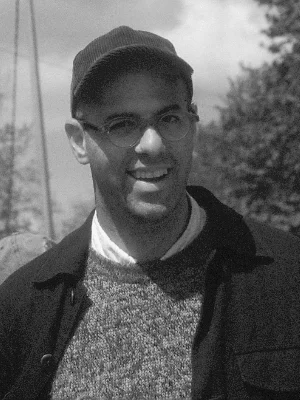
Avinoam Joseph Stillman is a historian with expertise in Jewish esotericism (kabbalah, Sabbatianism, Hasidism), Jewish book cultures (manuscript and print), and the Ashkenazi and Sephardi diasporas in Central Europe and the Eastern Mediterranean
.
He is currently a Starr Fellow in Judaica at Harvard University in 2025-2026, having received his doctoral degree at Freie Universität Berlin in 2025. Previously, he completed his MA in Jewish Thought at Ben Gurion University of the Negev and his BA in Religion at Columbia University.
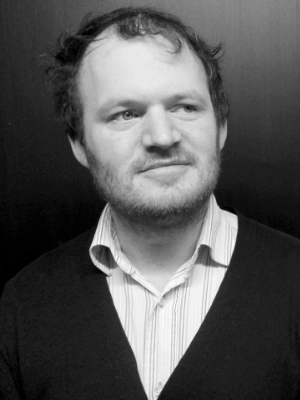
Stefan Goltzberg, Research Professor at the Université libre de Bruxelles (FNRS).
He published books on the sources of law (Les sources du droit, Que sais-je?? 3rd edition, 2024), comparative law (Le droit comparé, Que sais-je?, 2nd edition, 2024) and legal reasoning (L’argumentation juridique, Dalloz, 5th edition, 2024). His field of research is now comparative legal reasoning, including Talmudic law. Among his published papers:
“Three moments of Jewish philosophy”, 2011, “Is the Bible Fiction?” 2014 and “Le contournement de la loi est-il hypocrite ? Statut de la ruse dans la loi juive”, 2016.
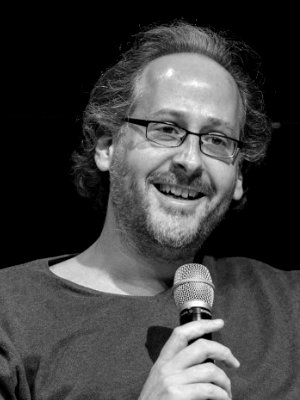
© Ruthe-Zuntz
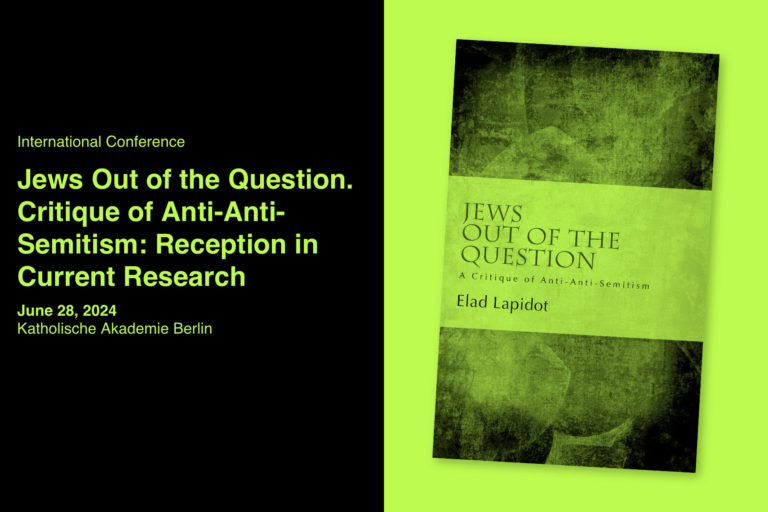
Elad Lapidot is professor for Culture Studies at the University of Lille, France. He specializes in philosophy, Jewish thought and Talmud and was teaching at the University of Bern, Switzerland, the Humboldt Universität Berlin and the Freie Universität Berlin. His work is guided by questions concerning the relation between knowledge and politics. Among his publications: Jews Out of the Question. A Critique of Anti-Anti-Semitism (SUNY Press, 2020), Hebrew translation with introduction and commentary of Hegel’s Phänomenologie des Geistes, Vol. 1 (Resling, 2020), Heidegger and Jewish Thought. Difficult Others, (Rowman & Littlefield, 2018), and Etre sans mot dire : La logiqe de ‘Sein und Zeit’ (Zeta Books, 2010).
Participants
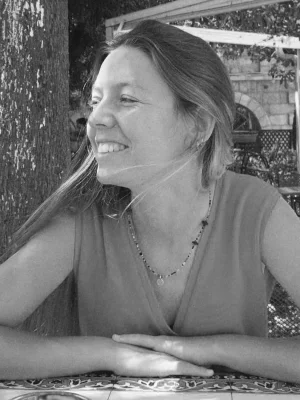
Ayala Chen Atkin holds a B.A. in Hebrew Literature and Psychology from the Hebrew University of Jerusalem, during which she also studied at University College London (UCL). She is currently pursuing an M.A. in Hebrew Literature at the Hebrew University, specializing in modern Hebrew literature, and serves as a teaching assistant in the department.
Ayala Chen is engaged in political activism, including work with the “Bnei Avraham” initiative and the “Lissan” organization, and she also works as a researcher and producer for the podcast “Shir Eres”. Over the past year, she has served as managing editor of “Makom”, a publishing house and journal affiliated with the “Smol Emuni” movment.

After bachelor studies in philosophy, Yiddish and Jewish studies, Sophie Bäärnhielm Pousette completed an MA in aesthetics (Södertörns högskola) and an MA and a PhD (2025) in modern European philosophy (CRMEP, Kingston University). Her doctoral thesis ‘A Political Theology of Participatory Sovereignty: The Acephalic Corpus of the General Will’, investigated the politico-theological legacy of St Augustine’s thought. Since the Fall of 2024 she has been a doctoral participant in the research project ‘Experimenting with Traditions’ at Södertörn University, Stockholm, which examines the encounter between Rabbinic-Hassidic tradition and German Enlightenment philosophy in early-twentieth-century Jewish-German thought. Her ongoing further doctoral study, ‘Translating Untranslatability: Words from the Verges of Tradition in Modern Jewish Thought’, combines her long-standing interest in political theology with the question of Jewish–Christian difference, with an emphasis on philosophies of language and translation, and the interpretation of Scripture.
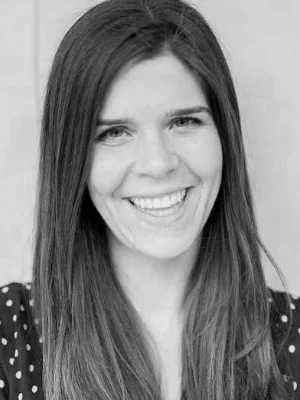
Elisabeth Becker is cultural sociologist and currently a Freigeist Fellow/Assistant Professor at the Max-Weber-Institute-for-Sociology, Heidelberg University, where she leads a project entitled “Invisible Architects: Jews, Muslims and the Construction of Europe”. She is also editor of Patterns of Prejudice. Elisabeth’s interests lie in diasporic thought and Jewish-Muslim relations. Her first book, Mosques in the Metropolis: Incivility, Caste, and Contention (University of Chicago Press, 2021), unites classical sociological and critical Jewish thought to offer a unique look into two of Europe’s largest urban mosque communities, highlighting the potentialities and failures of European pluralism.
Elisabeth’s work has appeared in various scholarly publications and she is also a public scholar who works with non-profit organizations and writes for mainstream outlets such as The Washington Post, New England Review, Frankfurter Allgemeine Zeitung, and Tablet Magazine. She is currently completing a crossover book Heimat: The Moving Lives of Jewish Berlin (forthcoming with Verso) and co-curating an exhibition on “Refiguring the Wandering Jew” with the Winchester Gallery.
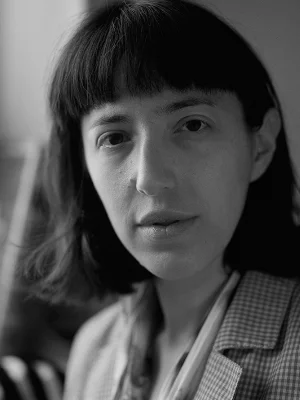
Avigail Ben Dor Niv
I am a Reform rabbi, scholar, and writer, born in Jerusalem in 1989 and ordained in Berlin in 2024. I currently serve as the rabbi of Migwan, the liberal Jewish community of Basel (the only woman serving as a community rabbi in Switzerland).
I hold a B.A. (cum laude) in Talmud and in the History and Philosophy of Science from Tel Aviv University and the Freie Universität Berlin, and an M.A. (cum laude) in Talmudic and Rabbinic Literature from the University of Potsdam. My master’s thesis demonstrated that the gender-specific obligation of the commandment of ״פרו ורבו״ (designated exclusively for men) was intentionally concealed from women; I showed that this too constitutes a case of “הלכה ואין מורין כן”, even though the rabbinic text actively attempts to obscure it.
I am currently developing my research on the ways women can penetrate the Talmudic text, often through modes of disguise, substitution, and narrative doubling, while reflecting on the textual constructions of womanhood and on my own future modes of action as a woman operating within rabbinic dimensions.
In my rabbinic work, I move in a רצוא ושוב rhythm- devotion and heresy, secular and religious, academic and mythical/mystical. I am also working on a new trilingual (German–English–Hebrew), gender-neutral Siddur.
Alongside my rabbinic scholarship, I also write about art and culture, and have studied and stil making film(s). I wrote a horror series set in Mea Shearim centered around a female demon and have edited dozens of documentary films and series on a wide range of subjects. I work across Hebrew, German, English, and Romanian.
In recent years I have turned to examining how German (or german-”jewish”) discourse attempts to impose a prescribed Jewish identity shaped by displaced guilt and hostility thinly veiled as ethical responsibility and a good old mix of ignorance – which affect my life in direct, tangible ways.

Isaac Cowhey is a second year rabbinical student at Heschel Seminar and a MA student in Jewish Theology at the University of Potsdam. In a prior life, Isaac was a software engineer, a cataloger of rare Hebraica, and a pastry chef. All of Isaac’s spare time is spent learning Talmud, reading bad mystery novels, and visiting every body of water in Berlin.
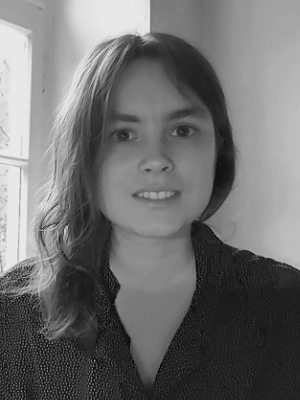
Dana Daymand is a research assistant at the chair for Jewish Studies at the University of Würzburg, where she teaches at the newly founded BA program in Diversity, Ethics, and Religions. Her academic interests revolve around philosophies of nature and Jewish receptions of Spinoza. She was trained in philosophy, political theory, and Jewish studies at Bard College Berlin, Tel Aviv University, Freie Universität Berlin, and the Hochschule für Jüdische Studien Heidelberg.
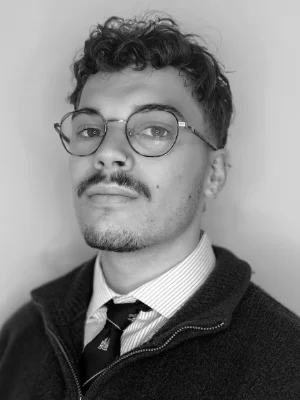
Isaac D’Henry is a master’s student at the École des Hautes Études en Sciences Sociales (EHESS), specialising in the study of the construction of religious identities and communal life in late antiquity. His research examines how rabbinic texts and synagogue archaeology together shaped religious identity in Byzantine Palestine, paying particular attention to the impoact of the synagogue an its impact in the socioeconomic realities of Jewish communities.
His current research focuses on the origins of organised charity, particularly the institution of the quppah (charity fund) in late-antique synagogues. He seeks to identify archaeological traces of these funds and to assess their function in social welfare and community cohesion. By exploring how the amoraic rabbinic discourse on organized charity and poverty relates with archaeological evidence, he aims of reconstructing the lived communal realities of Jewish communities in late antiquity.
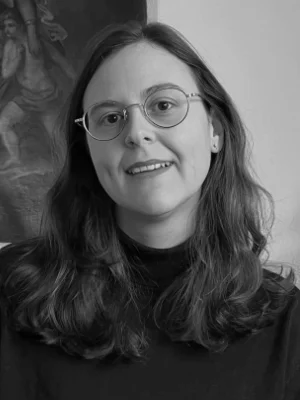
Hannah Sabrina Hübner is a PhD student at the Institute of Philosophy at Goethe University Frankfurt and an Associated Researcher at the Buber-Rosenzweig Institute for Jewish Cultural and Intellectual History. Trained in Philosphy, Sociology, Political Science, and Economics, stations in her biography include the Cologne Center for Comparative Politics, the Moscow Higher School of Economics, the Max Planck Institute for the Study of Societies, and the École Normale Superieure in Paris. Her doctoral dissertation focuses on the political theology of Walter Benjamin and Franz Rosenzweig, funded by the Polytechnic Foundation of Frankfurt am Main and under the supervision of Christoph Menke and Christian Wiese. Besides her teaching activity at the Institute of Philosophy at Goethe University, Hannah lives in Berlin where she just started to learn Ivrit.
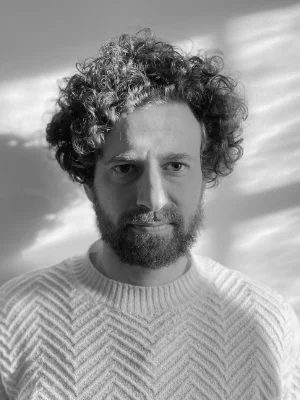
Gabriel Itkes-Sznap is a Swedish Poet and researcher in Aesthetics.
He holds a PhD in Aesthetics from Södertörn University (Stockholm), has published three books of Poetry and is currently a visiting scholar at Berlin University of the Arts (UdK).
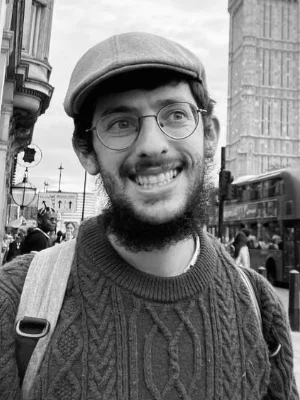
Avraham Oriah Kelman is a PhD candidate in the Department of Religious Studies at Stanford University. His work primarily engages with Jewish intellectual and cultural history in the late medieval and early modern periods, from Spain through the Middle East to Central and Eastern Europe. His dissertation tackles the relations between the production of knowledge and spatial imagination and experience, as it played out in the writings and practices of early modern kabbalists in the Middle East and Europe. His articles were published in various academic journals, and he is the co-editor of the forthcoming volume, As Messianism Turns to Heresy: The Regenstein Chair Lectures on Lurianic Kabbalah and Shabbatai Tzevi at Hebrew Union College Cincinnati, 1966.

Joshua Krug is a scholar-teacher of modern and contemporary Jewish Studies affiliated with the Heschel Rabbinical School in Potsdam. He holds a B.A. from Yale, an M.Div. from Harvard, and a Ph.D. from NYU. His work ranges across shifts in Jewish identity, memory, and education. A poet as well as an educator, Krug brings together scholarship, community engagement, and creative expression in his commitment to cultivating Jewish and intellectual life, learning, and renewal.
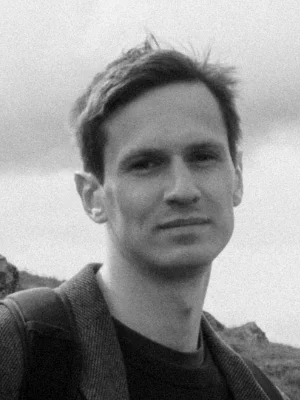
Georgy Layus is a PhD student at the Institute of Philosophy, KU Leuven, Belgium working under the supervision of Willem Styfhals and Agata Bielik-Robson. He is currently working on the concept of signature in contemporary continental philosophy with a focus on Giorgio Agamben, Jacques Derrida, Walter Benjamin, and Gershom Scholem. He has published several articles, including “To Live Means to Read: Agamben’s Messianism as an Archaeological Inquiry” (International Journal of Philosophy and Theology, 2023) and “Walter Benjamin and the Violence of Seal: Making History Legible by Interrupting the Myth” (The Palgrave Walter Benjamin Handbook, 2025). Recently he has been working on a paper “A Science of Ruins: Why Does Agamben Sympathise with Putin’s Russia?” which is going to be published soon.
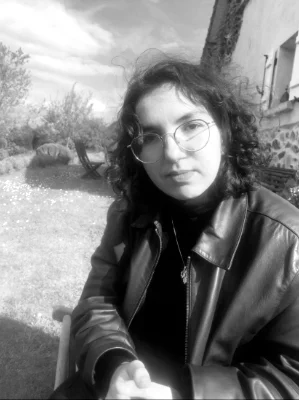
Alexia Levy-Chekroun holds a Master’s degree in Public Affairs from Université Panthéon-Sorbonne, and is a PhD candidate at Ecole des Hautes Etudes en Sciences Sociales (EHESS)/Université de Lille. Her dissertation seeks to explore the conflictual ways to envision « decolonial Jewish emancipation », through the lenses of talmudic and embodied epistemologies.

Hedda Lindstedt Grahn is a PhD candidate at Södertörn University in the Study of Religions. Her dissertation project explores how the relationship between corporeality, spirituality and male identity is manifested and conceptualised in modern Hasidic texts.
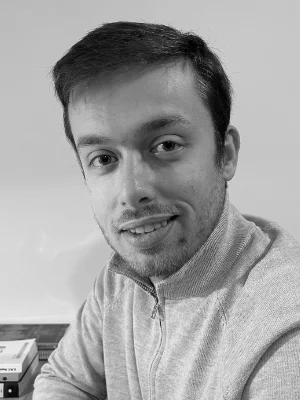
Daniel Méndez is a PhD candidate in Humanities at Pompeu Fabra University (Barcelona), focusing on modern political theology and Jewish thought. His research explores the intersections of political philosophy, anarchism, and messianism, with a particular focus on the work of the German-Jewish thinker Gustav Landauer. He is especially interested in questions of community, exile, and modernity from a philosophical and theological perspective.
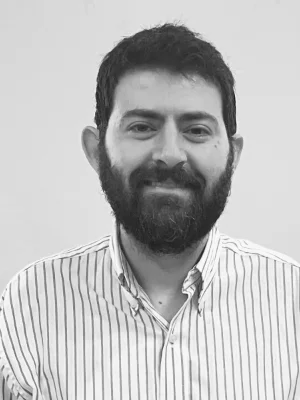
Jesse Mirotznik is a scholar of the Hebrew Bible, as well as its interpretation in ancient Jewish literature. He earned his PhD from Harvard University, completed Lady Davis and Golda Meir Postdoctoral Fellowships at The Hebrew University of Jerusalem, and is now a Postdoctoral Fellow at Bar-Ilan University. In his research, he investigates how biblical Israelites and their ancient Jewish successors imagined other religions.
His book on this topic is forthcoming with Cambridge University Press.
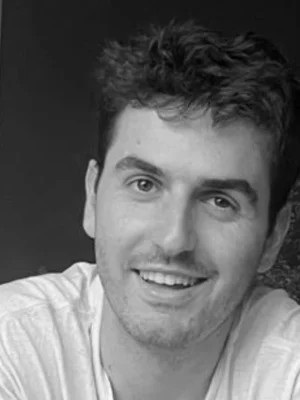
Micah Newberger studies poetics and philosophy. Working in and across the Greek, Jewish, Arabic, and German traditions, he is focused on al-Andalus and modern Germany. He was a Fulbright Scholar in Berlin is currently a PhD student at Harvard.
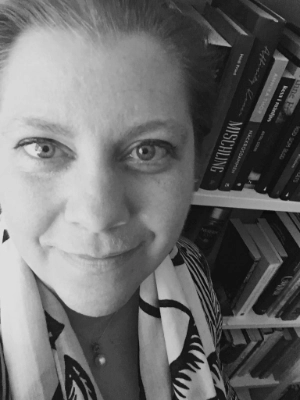
Malin Norrby a Ph.D. candidate in The Study of Religion at Södertörn university, where she is a participant in the research project Experimenting with Tradition: The Life and Afterlife of 20th Century Jewish Intellectual Culture in the Baltic Sea Region. Her current research interest is Jewish thought as Soviet Jewish Second culture from the Khruschev thaw to the late Soviet era. Malin has previously worked with the research project Traces of Yiddishkeit at Södertörn university.
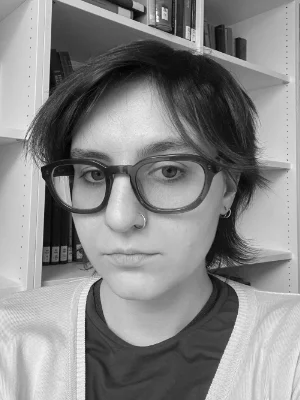
Hanna Perezolova-Sedletsky is a research assistant and a PhD candidate at the Institute of Jewish Studies of Freie Universität Berlin. They received training in Middle Eastern and Jewish Studies at the Higher School of Economics, Hebrew University of Jerusalem, Pardes Institute for Jewish Studies, and Freie Universität Berlin. Hanna’s research interests include phenomenological hermeneutics in rabbinic literature, gender in ancient Near East and Antiquity, and Talmudic epistemology.
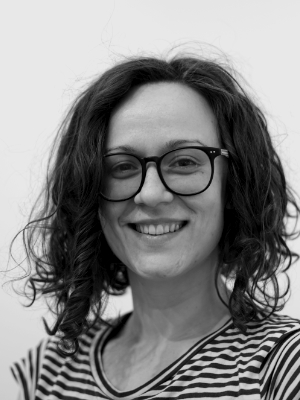
Ena Raphaëlle Oskar Schulz is currently a research fellow at the German Study Center in Venice, where she is developing the project The World at the Fingertips, which investigates the first complete printed edition of the Babylonian Talmud by the Christian printer Daniel Bomberg in sixteenth-century Venice. Bringing together Jewish Studies, Book History, Religious Studies, and Sensory Studies, the project shifts attention from the printed Talmud as a purely textual or technological achievement to the embodied, sensory, and collaborative dimensions of its production and use. Some of the questions the project asks are: What did the processes of typesetting, printing, and studying sound, smell, feel, and look like, and how did the printed Talmud transform religious practice, cultures of learning, and users’ experiences of belonging? Through a combination of historical research, material bibliography, creative reconstruction, hands-on printing, collective Talmud study, and spatial-sensory exploration of Venice, the project seeks to reconstruct and reactivate the lost sensory worlds of early modern Jewish textual culture. Its outcomes will be shared in both scholarly and public-facing formats, including a written study, a printed book, and a performative, sensorial walk through the city that makes the history of printing newly accessible as a bodily, lived experience.
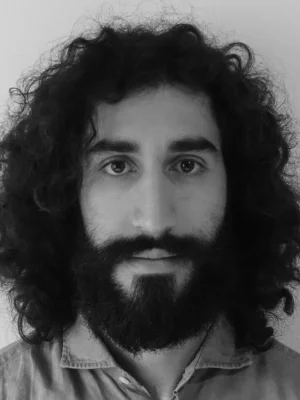
Francesco Scollo (Catania, 1999) is a PhD student in Philosophy at Vilnius University. He holds a Master’s degree in Theoretical Philosophy from the University of Turin and completed the excellence program at the “Ferdinando Rossi” School of Advanced Studies (SSST). He has undertaken research and study stays at Paris 8 University, the Scuola Superiore di Catania (SSC), the École Normale Supérieure in Paris and Vilnius University. His research spans the philosophy of history, philosophy of religion and political theology, with a current focus on the systematic study and renewed reception of Susan Taubes’s work.
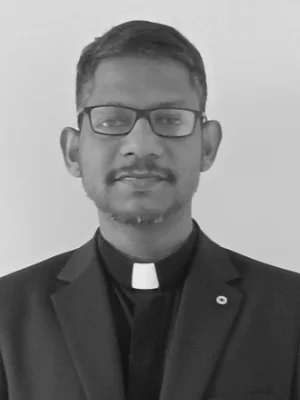
Filix Yohannan is an experienced biblical theologian and priest (Malankara [Indian] Orthodox Church) with expertise in Old Testament studies and Biblical Hebrew. Originally from India, he is now living in Berlin, Germany.
He pursued his foundational theological and master’s degrees (STB/BTh and STL/MTh) at the Pontifical Gregorian University in Rome, Italy, and earned his STD/DTh from the Pontifical University of St. Thomas Aquinas (Angelicum).
Dr. Filix served as an Assistant Professor of Old Testament and Hebrew at the Orthodox Theological Seminary in Kottayam, India, from 2016 to 2022. His research focuses on Old Testament exegesis, the Psalms, Hebrew linguistics, and biblical theology. He is motivated to pursue postdoctoral research and contribute to the academic community.
Program
| December 16 | |
| 9:00– 9:30 | Coffee |
| 9:30–10:00 | Greetings and Introduction |
| 10:00–11:00 | Session History Avinoam Stillman |
| 11:00–11:30 | Coffee Break |
| 11:30–12:30 | Session Philosophy Libera Pisano |
| 12:30–14:00 | Lunch |
| 14:00–15:00 | Session Hermeneutics Oded Schechter |
| 15:00–15:30 | Coffee Break |
| 15:30–16:30 | Small group text study |
| 16:30–17:00 | Break |
| 17:00–18:00 | Participant Project Presentations |
| 18:00–19:00 | Dinner |
| 19:00–20:30 | Public Lecture: Libera Pisano “The Exile of Language” Respondent: Gabriel Itkes-Sznap |
| December 17 | |
| 9:30–10:00 | Coffee |
| 10:00–11:00 | Session History Avinoam Stillman |
| 11:00–11:30 | Coffee Break |
| 11:30–12:30 | Session Hermeneutics Daniel Boyarin |
| 12:30–13:30 | Lunch |
| 13:30–14:30 | Session Law Stefan Goltzberg |
| 14:30–15:00 | Coffee Break |
| 15:00–16:00 | Session Hermeneutics Oded Schechter |
| 16:00–16:30 | Coffee Break |
| 16:30–17:00 | Small group text study |
| 17:00–18:00 | Open Discussion |
| Free Evening |
| December 18 | |
| 9:30–10:00 | Coffee |
| 10:00–11:00 | Session History Avinoam Stillman |
| 11:00–11:30 | Coffee Break |
| 11:30–12:30 | Session Philosophy Elad Lapidot |
| 12:30–13:30 | Lunch |
| 13:30–14:30 | Session Hermeneutics Daniel Boyarin |
| 14:30–15:00 | Coffee Break |
| 15:00–16:30 | Session Hermeneutics Oded Schechter |
| 16:30–17:00 | Coffee Break |
| 17:00–18:00 | Concluding Discussion |
| 18:00–19:00 | Free time |
| 19:00 | Dinner: Hummus & Friends |