

1ST CONFERENCE
MUSLIM, JEWISH, AND CHRISTIAN THINKERS
19TH TO 21ST CENTURY NORTH AFRICA
July 9–10, 2026
Catholic Academy in Berlin
Erg Chebb Sunset © via Wikimedia Commons
1ST CONFERENCE
MUSLIM, JEWISH, AND CHRISTIAN THINKERS
19TH TO 21ST CENTURY NORTH AFRICA
July 9–10, 2026
Catholic Academy in Berlin
In 2025, the research group, “Muslim, Jewish, and Christian Thinkers in 19 th – to 21 st -Century North Africa,” was founded with the three objectives: recovering and reevaluating the NorthAfrican philosophical tradition, creating a transnational research network, and establishing a counter-narrative to the dominant Western conception of modern philosophy. This. conference is the first annual conference organized within the framework of this research group.
Philosophy as it is taught today remains largely framed by the Western divide between continental and Anglo-American traditions, while overlooking and even marginalizing a central reality: the dynamic expansion, reception, and re-elaboration of philosophical thought beyond the bounds of Christian Western learning centers. This expansion unfolds geographically—through the appearance or reappearance of philosophical work in the Middle East, Africa, and Asia—as well as religiously, linguistically, and culturally, with the development of new approaches and new disciplines studying the Jewish, Islamic, African, Buddhist, and Hindu cultural heritages (including philosophy) in both established and emerging academic epicenters.
In this broader expansion of philosophy beyond Christian Western borders, North Africa presents a particularly compelling case. The region was home to important philosophical centers in Late Antiquity and the Middle Ages. In the 19 th and 20 th centuries, philosophical activity re-emerged in the context of Muslim reform movements seeking to transform society, economy, and political structures (Mehmet Ali, Khayr Al-Din), and under the growing European colonial presence. Both reform and colonial projects were shaped by modern Christian philosophical conceptions of the market economy, scientific knowledge, technology, religious reform, and the modern state apparatus. In this great turmoil of Muslim reforms and Christian colonization, Jews played an important role, moving between the traditional status of a protected minority and, in the colonial context, the status of a newly emancipated minority (notably in Algeria after the 1870 Cremieux Decree).*
These historical shifts transformed philosophical discourse across Christian, Muslim, and Jewish contexts, producing remarkable intellectual moments: 19 th -century Muslim and colonial modernization projects; the articulation of the Liberal–Islamist divide in the early 20 th century; the anticolonial nationalism of the 1940s–1960s; Christian, Jewish, and Muslim reflections on the Algerian War and colonialism; postcolonial debates over the failures of national liberation; and the philosophical responses to migration to Europe and Israel. The resulting body of thought constitutes a distinctive philosophical tradition, with prominent figures such as Taha Hussein, Abdel Rahman Badawi, Abdallah Laroui, Mohammed Abed al-Jabri, Mohamed Arkoun, Hasan Hanafi, Jacques Derrida, Albert Memmi, Hélène Cixous, Edmond Jabès, Louis Massignon, Albert Camus, and others – a tradition that has never been studied comprehensively.
In times of resurgent nationalism and inter-religious tensions and wars, studying the transnational, transcultural, and interreligious creativity of philosophy in North Africa offers an alternative vision of the region – one that challenges its present-day image as intellectually stagnant. Far from being a philosophical periphery, North Africa is a vibrant intellectual sphere in conversation with European and American thought. As a contact zone between East and West, between Islam, Christianity and Judaism, it was both the object of European Orientalism and colonialism and a site of intellectual agency, where the assumptions of European philosophy were, and are, questioned and reconfigured.
Organisation
Cedric Cohen-Skalli, University of Haifa
Christoph Hopp, University of Potsdam, University of Haifa
Elad Lapidot, University of Lille, Katholische Akademie Berlin
Cooperation





Participants and Abstracts
July 9 09:30
OPENING ADDRESSES
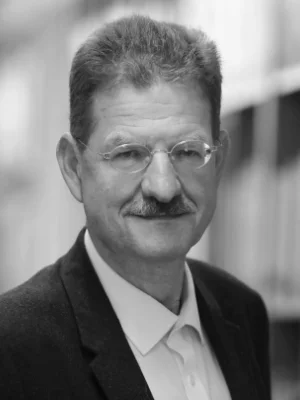
Christian Wiese is the Martin-Buber-Professor for Jewish Religious Philosophy and the director of the Buber-Rosenzweig-Institute for Modern and Contemporary Jewish Intellectual and Cultural History at Goethe University Frankfurt. He is also (with Menachem Fisch) the co-director of the transnational Frankfurt-Tel Aviv Center for the Study of Religious and Interreligious Dynamics. As the academic coordinator of the LOEWE-Center Dynamics of Religion: Ambivalent Neighborhoods between Judaism, Christianity, and Islam in Historical and Contemporary Constellations, he leads a large interdisciplinary and interreligious cross-university research center based at Goethe University Frankfurt, Philipps University Marburg, and Justus-Liebig-University Giessen. His own research is devoted, inter alia, to modern Jewish intellectual history and philosophy as well as the study of interreligious dynamics.
July 9 10:00
TOCQUEVILLE, ABD EL-KADER, AND CREMIEUX ON ALGERIA
Cedric Cohen-Skalli
University of Haifa
During the nineteenth century, the Ottoman Regency of Algeria was progressively conquered by the French army. Algeria became a territory in constant warfare, with changing borders, rules, and populations. The conflict opposed changing actors. On the one hand, there was the Ottoman Regency of Algiers, followed by the government of Abd El-Kader, and then the revolts of tribes. On the other hand, there was the French monarchy of Charles X (the Restauration), the liberal monarchy of July, the French Republic of 1848, the Empire of Bonaparte III, and the Third Republic.
This paper addresses, for the first time, the different political, philosophical, and religious imaginations of nineteenth-century Algeria advanced by three prominent intellectual figures. First, Alexis de Tocqueville (1805–1859), who wrote several plans concerning the colonization of Algeria. Second, Abd El-Kader (1808–1883), the political and religious leader of the Muslim opposition to the French colonization between 1832 and 1847, who wrote important philosophical and mystical treatises after his years of battle and imprisonment. Third, Adolphe Crémieux (1796–1880), a leading French-Jewish lawyer and politician, who played a major role in a series of decrees concerning Algeria, among them the famous decree that granted Algerian Jews French citizenship, but not the country’s Muslim subjects.
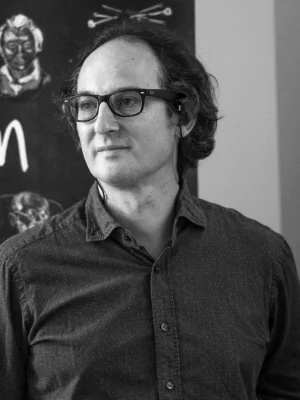
Cedric Cohen-Skalli is Professor of Jewish history and philosophy at the University of Haifa, Israel. He is the Director of the Bucerius Institute for the Research of Contemporary German History and Society and Chair of the Department of Jewish History and Bible. His field of research is interreligious intellectual history. He is a translator of many works and has published several books and many articles on diverse intercultural aspects of Jewish thought and literature in the Renaissance and in the nineteenth and twentieth centuries.
His intellectual biography of Isaac Abravanel was published in Hebrew and English by Shazar and Brandeis presses. He co-edited the volumes Skepsis and Antipolitics: The Alternative of Gustav Landauer (Brill 2022), Modern Jewish Thought on Crisis Interpretation, Heresy and History (De Gruyter 2024), and Women Writing Buber (Brill 2026). Cohen-Skalli is about to publish a new book with the title Forgotten Paths to Modernity: Isaac Abravanel, New Imperial Thinking and Critical Historiography in the UPenn Jewish Culture and Context series.
July 9 11:15
HUSAYN AL-MARSAFI (1815-1889) AND THE REORDERING OF POLITICAL VOCABULARY
Ufuk Topkara
Humboldt University of Berlin
This presentation examines the Egyptian scholar Husayn al-Marsafi through the lenses of translation and the intellectual history of Islam. The focus lies on his work Risālat al-Kalim al-Thamān (The Epistle of the Eight Words), in which Marsafi enacts a remarkable paradigm shift. Despite having no direct familiarity with Western philosophy, Marsafi adopted an original methodical approach: he criticized and reformulated central Islamic conceptual terms in an unprecedented manner. By analyzing concepts such as ummah (community), waṭan (homeland), or ḥurriyyah (freedom), Marsafi transformed them within a framework that marks the transition from traditional orders to modern political identities. This paper explores how Marsafi’s linguistic recalibration constructed an intellectual bridge between classical scholarship and nineteenth-century reform discourse, avoiding the mere imitation of Western concepts.
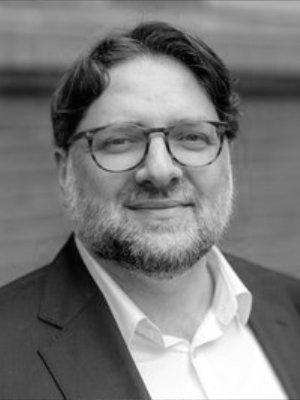
Ufuk Topkara, is a Professor at Humboldt University of Berlin in the field of Comparative Theology from an Islamic perspective. His research brings Islamic theology into conversation with contemporary philosophy and with Jewish and Christian theologies, including intra-Muslim comparative questions.
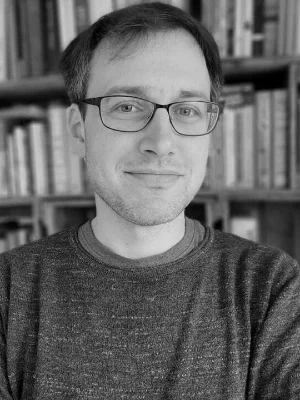
July 9 12:30
«ESSI MI APPAIONO COME EBREI DEL TEMPIO»: ITALIAN-JEWISH PHILOSOPHICAL DEBATES ON THE ORIGINS OF ETHIOPIAN AND NORTH AFRICAN JEWRY UNDER FASCIST COLONIALISM
Sebastian Musch
Osnabrück University
This paper investigates how Italian-Jewish thinkers conceptualized the relationship between Italian, North African, and Ethiopian Jewry following the Italian conquest of Ethiopia (1935–1937). Specifically, it examines how these thinkers’ quest for primordial origins was shaped by the increasingly precarious position of Italian Jews under Fascism. In order to do so, the paper argues that figures such as Carlo Alberto Viterbo, among others, were forced to renegotiate their status as Italians when confronted with the otherness of Ethiopian Jewry. Focusing on the period of the Italian occupation (1935–1941) as well as the Racial Laws from 1938, the paper demonstrates how expanded contact with Ethiopian Jewry challenged the carefully navigated assimilation of Jews under the Mussolini regime against a shifting political landscape. As a result, these thinkers developed a new taxonomy of the Jewish people, constructinga dichotomy between ancient and modern Judaism. In this taxonomy, Italian Jews were positioned as the pinnacle of modernity, North African Jews as a transitional middle ground, and Ethiopian Jews as an atavistic residue of the biblical era. Ultimately, the paper discusses whether these Italian-Jewish thinkers were adopting a Fascist logic of origins in their attempt to secure their own place within the Italian colonial empire.
Sebastian Musch holds a Ph.D. in Jewish Studies from the Center for Jewish Studies in Heidelberg and is currently the Alfred Landecker Lecturer at Osnabrück University, where he serves as the PI of the project «The Holocaust Migration Regime.» In 2022, he was a Polonsky Fellow at the Oxford Centre for Hebrew and Jewish Studies, and in 2024, a Harry Starr Fellow in Judaica at Harvard University. In addition, he has held fellowships and visiting positions at UC Berkeley, University of Haifa, Dartmouth College, KU Leuven, University of Southampton, and Università Vita-Salute San Raffaele. He has published widely on Jewish history. His first monograph, Jewish Encounters with Buddhism in German Culture: Between Moses and Buddha (1890-1940), was published by Palgrave Macmillan. His second monograph, Rabbiner gegen das Vergessen: Das bewegte Leben des Zvi Asaria, is forthcoming in 2026 with Campus Verlag. He is currently writing a third book titled Challenging the Abrahamic Triad: Buddhism, Antijudaism, and the Global History of Religion.
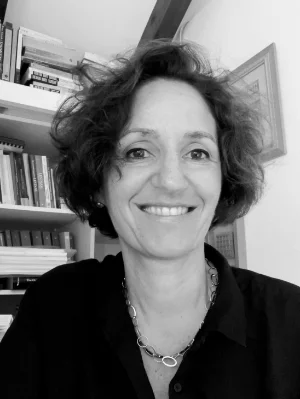
July 9 15:00
BETWEEN EXPERIENCE AND CONCEPT: ALBERT MEMMI‘S PHENOMENOLOGY OF COLONIAL HOME
Annabel Herzog
University of Haifa
This paper argues that Albert Memmi should be read not simply as a sociologist of colonialism but as one of its most rigorous phenomenologists – and that what his phenomenology ultimately describes is the paradox of colonial home. Against readings that treat the hybridity of his work—moving between novel, autobiography, political essay, and sociological analysis—as a sign of conceptual instability, I contend that this heterogeneity is deliberate and necessary. Colonial domination fractures the very possibility of being at home; no single genre can render this fracture. Memmi’s writing therefore performs what it describes: the impossibility of inhabiting a stable dwelling within the colonial order.
Reading The Colonizer and the Colonized alongside The Pillar of Salt and Portrait of a Jew, I show how Memmi develops a phenomenology of colonial home in North Africa. Colonialism, in his account, does not merely impose political or economic constraints; it organizes perception, self-relation, and belonging. It produces identities that subjects must inhabit as if they were home, even as they experience their fundamental uninhabitability. Memmi’s analysis proceeds from within this imposed interiority—a home that is never one’s own—refusing the comfort of theoretical distance. Placing Memmi in tension with Hannah Arendt’s account of imperialism in The Origins of Totalitarianism clarifies what is at stake. Arendt maps the institutional logic of empire and its consequences for law and citizenship – the political destruction of home. Memmi exposes the lived consequences of those structures: what it means to dwell within a home that has been colonized from within. If Arendt provides a theory of imperial power, Memmi reveals its existential grammar. His work thus challenges postcolonial theory itself: critique cannot remain at the level of concepts alone. It must risk new forms of writing capable of registering the displacement colonialism produces at the heart of home.
Annabel Herzog is Professor of Political Theory at the School of Political Science at the University of Haifa, Israel. Her research focuses on twentieth-century continental philosophy and Cultural Studies, and contemporary Jewish thought, exploring the connections between ethics and politics and between phenomenology and literature. Her last book, Levinas’s Politics: Justice, Mercy, Universality (Philadelphia: University of Pennsylvania Press, 2020), was the recipient of the 2021 Jordan Schnitzer Book Award in Philosophy and Jewish Thought.
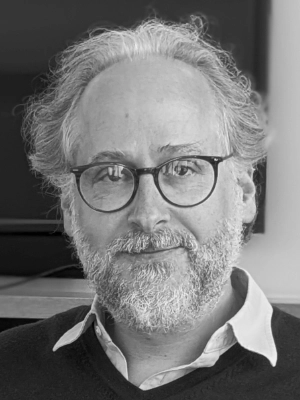
July 9 16:15
IN ALGERIA, I DISCOVERED THE IMPORTANCE OF THE PALESTINIAN PROBLEM: ILAN HALEVI AND THE JEWISH PLO
Elad Lapidot
University of Lille
This talk examines the political and intellectual trajectory of Ilan Halevi (1943–2013), focusing on his formative experience in Algeria and his subsequent role within the Palestine Libera-tion Organization (PLO). Halevi, a French-born Jewish intellectual who emigrated to Israel and later became an official representative of the PLO, embodied a political position that unsettles conventional binaries between «Jewish» and «Palestinian,» «Zionist» and «anti-Zionist.» The title quotes Halevi’s own recollection that it was in postcolonial Algeria—then a hub of Third Worldist internationalism—that he grasped the centrality of the Palestinian question. In Algiers, capital of revolutionary diplomacy in the 1960s and 1970s, the Palestinian struggle appeared not as a regional conflict but as a nodal point of global anticolonial politics. The lecture situates Halevi within this Algerian moment and traces how it shaped his critique of Zionism, his understanding of Jewish history, and his advocacy of a secular, binational future in Israel-Palestine. Particular attention will be given to the idea of the «Jewish PLO»: Jewish militancy which, without renouncing its Jewishness, aligns itself with the cause of Palestinian liberation. The talk explores how Jewishness was rearticulated from within the Palestinian movement – as a diasporic, anti-colonial, and non-sovereign political position.
Elad Lapidot is Professor of Jewish Thought at the University of Lille, France. His work is guided by questions concerning the relation between knowledge and politics. Among his publications: State of Others: Levinas and Decolonial Israel (Bloomington: Indiana University Press, forthcoming), Politics of Not Speaking (Albany: SUNY Press, 2025), Jews Out of the Question: A Critique of Anti-Anti-Semitism (Albany: SUNY Press, 2020), Hebrew translation of Hegel’sPhänomenologie des Geistes (Tel Aviv: Resling Publishing, 2020), Heidegger and Jewish Thought: Difficult Others, edited with M. Brumlik (London/New York: Rowman & Littlefield, 2018), and Etre sans mot dire : La logique de ‘Sein und Zeit’ (Bucarest: Zeta Books, 2010).
July 9 17:30
WOUNDED TONGUES, TATTOOED MEMORIES: READING HASSOUN, KHATIBI, AND DERRIDA TODAY
Rachid Boutayeb
Doha Institute for Graduate Studies
Khatibi and Hassoun agree, each in their own way, that we need to rethink our origins and the relationship that connects us to them. Hassoun through psychoanalysis and Khatibi through deconstruction. This critical relationship with our origins requires openness to language or languages, and to others, in search of a different way of thinking (Pensée-autre), of writing outside the book, or of writing of the même livre with more than one hand, beyond the illusions of identity and the wounds of memory.
The dialogue between the two focuses on the Arab-Jewish question, and the interlocutors touch on a range of topics in their discussion: history, language, religion, colonialism, postcoloniality, Western modernity, etc. However, both emphasize, albeit in different ways, the need to rethink or question origins in light of modernity and its achievements. In my presentation, which is based on the correspondence between Hassoun and Khatibi as well as further reflections by the authors on the subject of language and memory, I focus on the concept of bilangue as a deconstruction of the concept of the book and identity and as a call for a kind of ethics of chiasmus that acknowledge the other as a constituent of the self without attempting to bring him into the totality of the same.
This opens the way to another dialogue, which can be seen as a continuation of the first, this time bringing together Khatibi and Derrida. It is a dialogue that continues to deconstruct the dialogue itself and its presuppositions, as well as any reflection on language as belonging.
Rachid Boutayeb is an Associate Professor of Social Philosophy and Ethics at the Doha Institute for Graduate Studies. He has previously worked as a Lecturer in Philosophy, Anthropology, and Islamic Studies at various German universities. He authored numerous research papers focusing on the ethics and social philosophy of migration. His most recent publications include Tristesse oblige: Eine kleine Philosophie der Nachbarschaft (Alibri 2022) and Modernity and Contemporaneity: Ideas for an Intercultural Philosophy (in Arabic, Arab Center for Research and Policy Studies 2024).
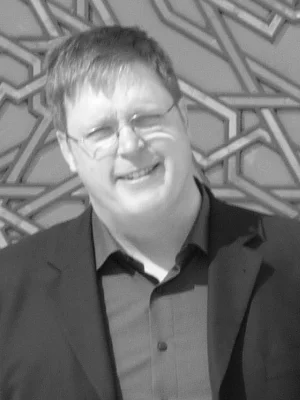
July 10 09:30
SUR LES RESSOURCES JUIVES ET CHRÉTIENNES DU «PERSONNALISME RÉALISTE» DE MOHAMED AZIZ LAHBABI
Markus Kneer
University of Regensburg
Lorsque l’on évoque ici le «personnalisme réaliste» de Mohamed Aziz Lahbabi, il ne désigne pas seulement une période de son développement philosophique mais aussi le fondement de sa philosophie entière, sur lequel reposent tous les développements ultérieurs, y compris son «personnalisme musulman». Surtout ses trois livres De l’être à la personne, Liberté ou Libération ? et Du clos à l’ouvert font l’objet de cette enquête. Pour localiser la recherche des ressources juives et chrétiennes du personnalisme réaliste, il est d’abord nécessaire de présenter l’approche d’une philosophie de religion comparée que Lahbabi développe dans l’épilogue de De l’être à la personne. Cela peut aussi être décrit comme «l’anthropologie pluraliste des religions et des visions du monde», car elle place côte à côte les diverses expériences religieuses et idéologiques sur un pied d’égalité. L’expérience chrétienne est associée à la conversion. Il est cependant frappant que l’expérience religieuse du judaïsme ne soit pas mentionnée dans ce contexte. L’une des tâches consiste donc à rechercher la description lahbabiienne de l’expérience juive dans les autres écrits. Dans une étape supplémentaire, on examine les auteurs juifs et chrétiens, dont Lahbabi s’appuie pour développer son personnalisme réaliste. En plus, on peut aussi trouver des points critiques qu’il formule à l’égard des deux religions. Il serait nécessaire d’examiner ici dans quelle mesure Lahbabi s’efforce d’une interprétation qui reste équilibrée. En principe, cependant, Lahbabi peut être considéré comme un penseur qui soutient que l’identité du Maroc est plurielle et qu’elle est composée des différentes ressources.
Markus Kneer, prêtre diocésain et docteur en théologie catholique, est chargé de cours à la PTH Münster. Ses recherches portent principalement sur le personnalisme, les relations entre philosophie et théologie, la philosophie arabo-musulmane, le dialogue islamochrétien, l’antijudaïsme et l’antisémitisme. Il a récemment publié Person-Sein im Dialog: Christlich-Islamische Ressourcen des modernen Menschen, Pustet, Ratisbonne, 2024.
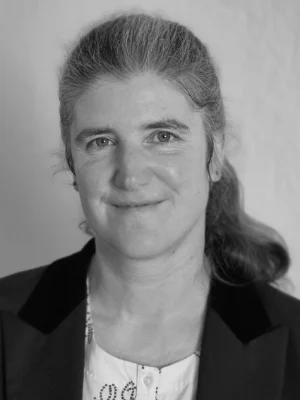
July 10 10:45
RAZIKA ADNANI’S CALL FOR SECULARISM IN NORTH AFRICAN AND ARABIC CONTEXTS
Kata Moser
University of Göttingen
Razika Adnani is an Algerian philosopher and Islamic studies scholar who now lives in France. Her publications in Arabic and French primarily focus on secularism, forming the basis of her critical examination of religious thought and socio-political traditions in the Arab world. Central to her approach to secularism is her call for the reform of Islam. She is also part of organizations safeguarding secularism in France.
In this article, I summarize Razika Adnani’s analysis of Arab discourses on secularism, the secularist theory, and Islam-based hostility towards it, as well as her response to this. I will demonstrate the close alignment of her ideas with the French concept of laïcité, which informs her analysis of the sociopolitical and intellectual situation in the Arab world, particularly in Algeria. Furthermore, I will demonstrate the extent to which her stance on this matter is part of the North African discourse on secularism, which notably differs from Middle Eastern perspectives. Characteristics include the avoidance of an explicit and normative theory of secularism and the idea of developing secularism from within local traditions, especially through the reform of Islam. While Adnani deviates from the former, she clearly displays the latter.
Kata Moser has been Professor of Secularism in Islamic Modernity at the University of Göttingen since October 2025. Previously, she was a Juniorprofessor at the same university, a research assistant at the Seminar für Orientalistik / Islamwissenschaft at the University of Bochum, and a research assistant at the Institut für Islamwissenschaft und Neuere Orientalische Philologie at the University of Bern (PhD 2014). She studied Islamic Studies, Theater Studies, and Philosophy at the Universities of Berlin, Bern, Leipzig, and Zurich (MA in Islamic Studies, Bern 2009).
Her studies and research took her to Syria, Lebanon, Morocco, Tunisia, Oman, and Iran. Moser’s research focuses on contemporary Arabic philosophy with a particular emphasis on theories of secularism, the reception of Heidegger, the philosophy of religion, and theater in the Arab world. She is co-editor of the book series Philosophie in der nahöstlichen Moderne / Philosophy in the Modern Middle East (De Gruyter, formerly Klaus Schwarz).
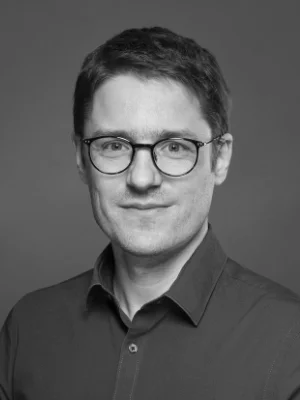
July 10 12:00
ARGUING WITH ARENDT IN ALGERIA: MALIKA BENDOUDA BETWEEN PAST AND FUTURE
Michael Frey
University of Bern
Hannah Arendt has long remained underrepresented in Arab intellectual debates, despite the apparent relevance of her thought to the political and social realities of the MENA region. Yet in recent years, some notable engagements with her work have emerged. A particularly illustrative example is offered by the Algerian philosopher and current minister of culture, Malika Bendouda (b. 1975). This paper offers an initial, historically grounded examination of Bendouda’s engagement with Arendt, approaching it from two perspectives.
On the one hand, it aims to disentangle the intellectual and political implications of what it means to argue with Arendt in the Algerian context of the present, understood against the backdrop of the country’s longer intellectual and political history. On the other hand, this paper reads Bendouda’s interpretation of Arendt as a lens onto what has recently been described as «the new contemporary» by intellectual historian Elizabeth Suzanne Kassab – a thematic and generational reconfiguration of contemporary Arab thought in the aftermath of the Arab Spring. It will be argued that, whereas Bendouda’s texts register both thematic continuity and conceptual rupture, her recourse to Arendt also indicates why Arendt may be emerging as an especially compelling theorist for this generation – one whose categories of action, plurality, and freedom speak to a post-2011 search for new forms of political organization and pluralist discourse.
Michael Frey is a Postdoctoral Researcher in Islamic and Middle Eastern Studies at the Department of Social Anthropology and Cultural Studies at the University of Bern. His research focuses on contemporary Arab philosophy, with particular attention to concepts of liberty. His monograph on the Lebanese philosopher Nassif Nassar received the Philosophy Book Award (Philosophischer Buchpreis) from the Hannover Institute for Philosophical Research in 2020. His recent publications include two translations in Global Secularity: A Sourcebook, Vol. 2: The Middle East and North Africa (Berlin: De Gruyter, 2024), edited by Florian Zemmin, Neguin Yavari, Markus Dressler, and Nurit Stadler, as well as the article «Arguing with Kant in the Postcolonial Middle East: Aḥmad Muḥammad al-Šaybānī and the Transcultural Journey of Critical Philosophy,» published in Die Welt des Islams (2026).
Program
| Thursday July 09, 2026 | |
| 09:00 | Arrival |
| 09:30 | Opening Addresses Christian Wiese, Goethe University Frankfurt Davide Assael, Associazione Lech Lechà |
| 10:00 | First Talk Cedric Cohen-Skalli, University of Haifa – Tocqueville, Abd El-Kader, and Cremieux on Algeria |
| 11:00 | Coffee Break |
| 11:15 | Second Talk Ufuk Topkara, Humboldt University of Berlin – Husayn al-Marsafi (1815–1889) and the Reordering of Political Vocabulary |
| 12:15 | Coffee Break |
| 12:30 | Third Talk Sebastian Musch, Osnabrück University – «Essi mi appaiono come ebrei del tempio»: Italian-Jewish Philosophical Debates on the Origins of Ethiopian and North African Jewry under Fascist Colonialism |
| 13:30 | Lunch |
| 15:00 | Fourth Talk Annabel Herzog, University of Haifa – Between Experience and Concept: Albert Memmi’s Phenomenology of Colonial Home |
| 16:00 | Coffee Break |
| 16:15 | Fifth Talk Elad Lapidot, University of Lille – In Algeria, I Discovered the Importance of the Palestinian Problem: Ilan Halevi and the Jewish PLO |
| 17:15 | Coffee Break |
| 17:30 | Sixth Talk Rachid Boutayeb, Doha Institute for Graduate Studies – Wounded Tongues, Tattooed Memories: Reading Hassoun, Khatibi, and Derrida Today |
| 18:30 | Conclusion |
| 19:30 | Dinner |
| Friday July 10, 2026 | |
| 09:00 | Coffee |
| 09:30 | Seventh Talk Markus Kneer, University of Regensburg – Sur les ressources juives et chrétiennes du «personnalisme réaliste» de Mohamed Aziz Lahbabi |
| 10:30 | Coffee Break |
| 10:45 | Eighth Talk Kata Moser, University of Göttingen – Razika Adnani’s Call for Secularism in North African and Arabic Contexts |
| 11:45 | Coffee Break |
| 12:00 | Ninth Talk Michael Frey, University of Bern – Arguing with Arendt in Algeria: Malika Bendouda Between Past and Future |
| 13:00 | Conclusion |
| 13:30 | Lunch |